A few years ago, enterprise AI mostly meant a customer-facing chatbot and a forecasting model sitting somewhere in the data science team's backlog. That picture has broadened considerably. AI now sits inside procurement, quality control, hiring, cybersecurity, and dozens of other functions that used to run almost entirely on spreadsheets and institutional memory, and enough of these systems have now been running in production long enough that the results are documented rather than promised. Getting from a working demo to something a business can actually rely on every day is still the hard part, and it's where a lot of AI initiatives lose momentum. Mid-market enterprises in particular often don't have the deep engineering bench that a much larger company can throw at the problem, which is part of why platforms like ATC Forge exist: to give smaller organizations the pre-built accelerators, governance, and multi-cloud flexibility that used to be reserved for companies with far bigger budgets. With that context, here's a walk through thirteen categories of enterprise AI already doing real work, each with a concrete example of it in action.
1. Predictive Analytics
Predictive analytics uses historical and real-time data to estimate what's likely to happen next, whether that's equipment failure, customer churn, or a spike in demand. Instead of reacting after something breaks, teams get a warning while there's still time to act. Rolls-Royce runs this at serious scale through its Engine Health Monitoring system, which tracks thousands of parameters on an aircraft engine in real time and feeds that data into models that flag maintenance needs before a part actually fails, letting airlines plan repairs around their schedules instead of around emergencies.
2. Intelligent Document Processing
Intelligent document processing combines optical character recognition, natural language processing, and machine learning to read, classify, and extract information from documents that used to require a person's eyes. JPMorgan Chase built a system called COIN for exactly this purpose. It now reviews commercial loan agreements that once consumed roughly 360,000 hours of legal work a year, pulling out key clauses and terms in seconds instead of weeks, and processing more than 12,000 credit agreements annually.
3. Conversational AI and Chatbots
Modern conversational AI has moved well past scripted decision trees. These systems use large language models to understand intent, hold context across a multi-turn conversation, and pull real answers from internal knowledge bases. Bank of America's Erica shows what this looks like at scale: more than 20 million customers interacted with it nearly 700 million times last year, and the bank runs a separate internal version that its own employees use to answer HR and IT questions. For where this category is headed next, The Top 4 AI Agents Transforming Customer Service in 2026 is worth a look.
Getting a conversational agent through a demo is the easy part. Getting it live, connected to real systems, with the right guardrails and monitoring, is where a lot of AI initiatives quietly stall. That jump from proof of concept to production is exactly where ATC's AI Services team spends most of its time, closing the gap between a promising pilot and something a business can actually run on.
4. AI-Powered CRM
AI-powered CRM platforms layer machine learning on top of the customer data already sitting in the system, turning records into predictions. Salesforce's Einstein scores every lead on its likelihood to convert based on patterns from past deals and generates an AI-adjusted sales forecast that sits alongside a rep's own estimate. Sales leaders get an early read on which deals are at risk and which leads are worth chasing first, without anyone building a model from scratch.
5. Supply Chain Optimization
Supply chain optimization tools solve routing, inventory, and logistics problems with far too many variables for a human planner to work through manually. UPS's ORION system analyzes package data, delivery windows, and live traffic to calculate the most efficient route for each of roughly 55,000 drivers, saving the company around 100 million miles and $300 to $400 million a year. It's a reminder that small per-route efficiencies compound into enormous savings at scale.
6. Fraud Detection
Fraud detection models look for patterns across transaction data that static, rules-based systems would miss entirely, things like unusual purchase locations, device fingerprints, or behavior that breaks from a customer's normal habits. PayPal leans on deep learning, computer vision, and natural language processing here, screening billions of transactions daily and blocking a large share of unauthorized activity before it completes. The models keep adapting as fraud tactics shift, rather than waiting for someone to write a new rule.
7. HR and Talent AI
HR and talent AI applies machine learning to recruiting, screening, and onboarding, tasks that are repetitive at scale but still need consistency and fairness. Unilever partnered with Pymetrics and HireVue to redesign its early-career hiring, using gamified assessments and AI-scored video interviews to evaluate hundreds of thousands of applicants a year. The company cut its hiring timeline from around four months to a matter of weeks, while also reporting gains in the diversity of who made it through the funnel.
8. Marketing Personalization Engines
Marketing personalization engines analyze individual behavior, preferences, and purchase history to tailor what each customer sees, instead of serving everyone the same offer. Stitch Fix runs one of the more sophisticated versions of this: its algorithms score every item in inventory on the likelihood a specific shopper will buy it, and that scoring feeds directly into what a human stylist curates for that customer's box. For more on where this space is moving, 5 AI Marketing Agents for Business covers some of the newer tools worth knowing about.
9. Computer Vision for Quality Control
Computer vision systems use cameras and trained image recognition models to catch defects that a tired or rushed human inspector might miss. BMW runs convolutional neural networks over high-resolution images of parts and painted surfaces on its production lines, flagging scratches, dents, and misalignments in real time. The company has reported defect reductions in the range of 30 to 40 percent at plants running the system, catching issues before a vehicle ever leaves the line.
10. Robotic Process Automation with AI
Traditional RPA followed rigid, rule-based scripts that broke the moment a form changed layout. Pairing it with AI, particularly document understanding, lets bots handle the variation that shows up in real business paperwork. Canon used this combination for accounts payable, deploying UiPath's Document Understanding to process roughly 40,000 invoices, and within nine months it was handling about 90 percent of them with no human intervention, well past its original target.
11. AI-Driven Cybersecurity
AI-driven cybersecurity tools learn what normal activity looks like across a network and flag deviations, rather than relying only on known threat signatures. Darktrace built its platform around this idea, describing it as a kind of self-learning immune system that can catch an attack it has never seen before because the behavior simply doesn't match the baseline. In documented cases, its Cyber AI Analyst can turn a novel attack into an incident report clear enough for a junior analyst to act on within minutes. As Shadow AI, The New Security Problem Companies Face explains, this category matters even more now that unsanctioned AI tools are creating blind spots of their own.
12. Demand Forecasting
Demand forecasting predicts what customers will want, where, and when, pulling in sales history, weather, and other signals to get ahead of a stockout or a markdown. Walmart forecasts demand down to the store-SKU-day level and pairs it with a self-healing inventory system that automatically reroutes stock to wherever it's needed most, a program the company has said saved more than $55 million. The result is fewer empty shelves and less inventory sitting unsold.
13. Generative AI for Content and Knowledge Work
Generative AI has moved from novelty to daily tool for a lot of knowledge workers, drafting first versions of documents, summarizing long threads, and pulling answers out of internal files. Globo, Brazil's largest media company, rolled out Microsoft 365 Copilot across its newsroom and cut the time to put together an industry news brief from about three hours to 30 to 60 minutes. That's not a small edge in an industry where being first with a story still matters.
Where This Goes Next
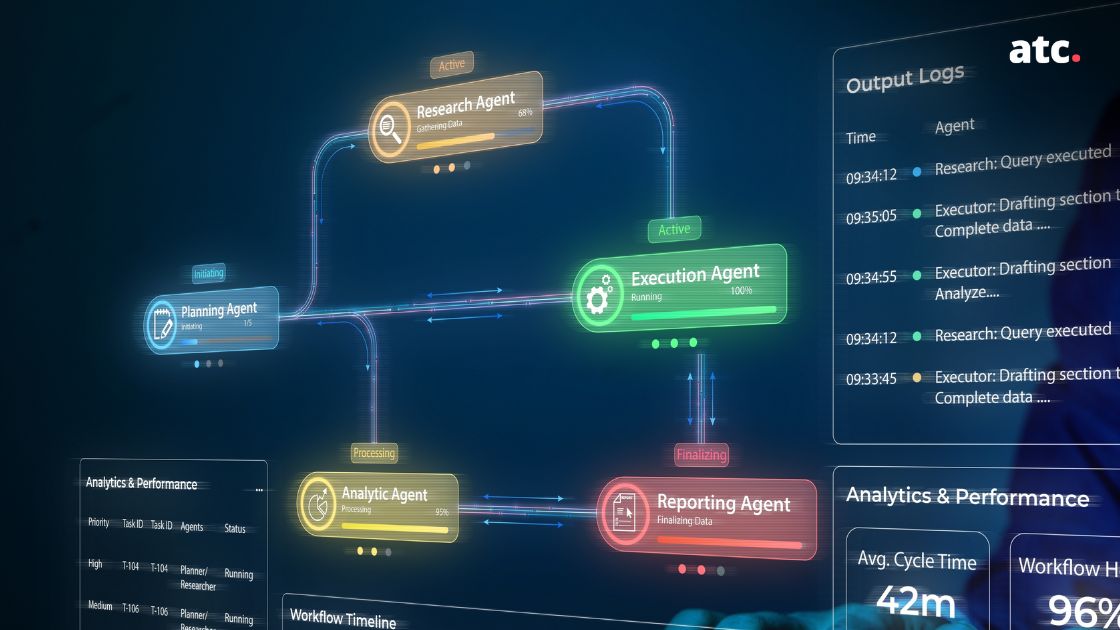
The next stretch of enterprise AI is less about adding a fourteenth category and more about getting these systems to work together. A document processing pipeline that hands off to a forecasting model that triggers a supply chain adjustment, all coordinated by orchestration rather than stitched together by hand, is already how the more advanced deployments operate, and it's likely to become the default rather than the exception. The companies that get there fastest won't necessarily be the ones with the biggest AI budgets. They'll be the ones that treat the platform and the delivery expertise as one package rather than two separate problems. That's the model behind ATC's approach: a platform built on more than 100 pre-built accelerators, paired with an AI Services team that focuses specifically on closing the gap between a working pilot and a system actually running in production. For a mid-market enterprise trying to move past pilots that never quite ship, that combination is worth a conversation.

Subscribe to the blog