Walk into almost any strategy meeting these days and someone will mention "automating things with AI." It sounds simple enough, until you ask a follow-up question. Are they talking about a chatbot that reasons through customer complaints, or a script that copies numbers from one spreadsheet into another? Nine times out of ten, nobody in the room can say for sure. The two words get used as if they mean the same thing, and that mix-up costs businesses real money when they end up buying the wrong solution for the problem they actually have.
This confusion isn't new, and it isn't going away on its own. If anything, it's gotten worse as more tools claim to be "AI-powered" whether or not there's much intelligence involved. Getting this distinction right matters, especially for teams trying to figure out where to invest first. A lot of the enterprises ATC works with come in asking for an AI project, and after a closer look at what they actually need, it turns out plain automation would solve it faster and cheaper. Others assume automation will handle something that genuinely requires judgment, and it can't. So before jumping into a build, it helps to slow down and understand what each of these things really does.
What Automation Actually Is
Automation is the older, more established idea of the two. At its core, it means getting a machine or a piece of software to carry out a task according to a fixed set of instructions, without a person clicking through it each time. Think of a factory line that welds car parts in the exact same sequence, hour after hour, or a script that pulls data from an email and drops it into a spreadsheet every morning at 6 a.m.
The defining trait here is predictability. Automation follows rules. Give it the same input, and it produces the same output, every single time. There's no interpretation, no weighing of options, no "it depends." That's precisely why it works so well for repetitive, high-volume tasks where consistency matters more than flexibility: payroll processing, invoice matching, data entry, scheduling reminders. Robotic Process Automation, often shortened to RPA, is a good example of this in the enterprise world. It mimics the clicks and keystrokes a human would make, just faster and without getting tired by hour eight.
What AI Actually Is
Artificial intelligence works differently. Rather than following a rigid script, AI systems learn patterns from data and use that learning to make decisions or predictions in situations they haven't seen before. A fraud detection model doesn't need someone to write out every possible way a transaction could be suspicious. It learns what fraud tends to look like and flags anything that resembles it, even in a form nobody anticipated.
That's the real distinction: adaptability. AI can handle ambiguity, weigh probabilities, and adjust its output based on context. Ask a large language model the same question twice and you might get two slightly different, equally valid answers, because it's reasoning rather than replaying a fixed set of steps. This is what allows AI to move into work automation could never touch: summarizing a messy customer complaint, generating a first draft of a report, or deciding which of five possible responses fits a situation best. ATC's team has written before about how agentic AI takes this a step further, giving systems enough autonomy to plan and execute multi-step tasks rather than just responding to a single prompt.
Where the Two Actually Overlap
Here's where it gets interesting, because AI and automation aren't rivals. In most real-world systems, they work side by side. Automation handles the repetitive, structured parts of a process. AI steps in for the parts that need judgment. Picture a customer service pipeline: automation might route a ticket to the right queue based on a keyword, while an AI layer reads the actual message, understands the sentiment behind it, and drafts a response that reads like it came from a thoughtful human.
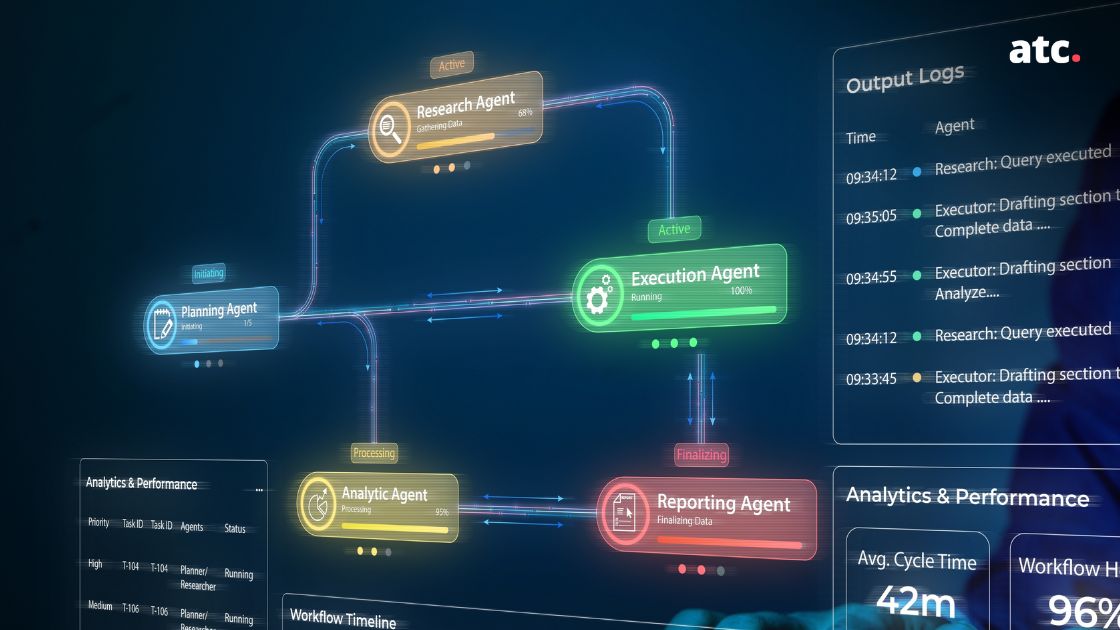
That combination, sometimes called intelligent automation, is quickly becoming the standard approach for enterprises that want more than just speed. They want systems that can actually think through edge cases without falling apart. This is a big part of why the ATC Forge Platform was built around multi-agent orchestration rather than a single monolithic model. Different agents can specialize in different tasks, with automation quietly running underneath to handle the plumbing, so nothing has to be over-engineered just to get a straightforward job done.
It's a pattern that shows up across industries. Retailers use computer vision, an AI capability, to track inventory, while automated systems reorder stock once levels dip below a threshold. Finance teams let AI flag unusual spending, then let automation route the flagged item to the right approver. Neither piece works alone as well as the two working together. ATC covered a version of this shift in a piece on the next phase of enterprise automation, pointing out that the old model of brittle scripts and glorified FAQ bots is giving way to systems that can actually reason and get things done.
Where They Genuinely Differ
So where does the line actually sit? A few things separate the two pretty clearly.
Automation is deterministic. It does exactly what it's told, nothing more, nothing less. AI is probabilistic. It makes its best judgment based on patterns, which means it can occasionally be wrong in ways a rule-based system simply can't be, because a rule-based system never guesses in the first place.
Automation needs rules written up front. Someone has to map out every step and every exception. AI needs data, and lots of it, to learn from. That's a fundamentally different kind of investment, and it explains why AI projects tend to take longer to get right and require more ongoing tuning.
Automation is cheap to build and easy to maintain once it's running. AI is more expensive upfront, and it needs monitoring over time since its behavior can drift as conditions change. This is one reason governance has become such a hot topic for enterprises adopting AI at scale, a subject ATC has explored in more depth when comparing AI governance and AI compliance.
And finally, scope. Automation is narrow by design. It does one thing, reliably. AI can generalize, at least to a degree, applying what it's learned to situations it wasn't explicitly trained for.
So, Which One Does a Business Actually Need?
The honest answer is that it depends on the problem, not on which technology sounds more impressive on a slide deck. If a task is repetitive, rule-based, and doesn't change much over time, automation is usually the faster and cheaper answer. Building an AI model to do what a simple script could handle is, frankly, overkill, and it tends to introduce complexity nobody asked for.
If the task involves judgment, unstructured information, or decisions that shift depending on context, that's where AI earns its keep. And for most mid-market and enterprise teams, the real opportunity sits in the overlap: using automation to handle the volume and AI to handle the nuance.
That's the exact gap ATC AI Services was built to close. Rather than treating AI as a leap of faith, the team walks businesses through an honest assessment first: what actually needs intelligence, what's better solved with straightforward automation, and where the two should be layered together. From there, it moves through rapid proof-of-concept work, full production deployment, and 24/7 managed operations, with the ATC Forge Platform's 100+ pre-built accelerators cutting down the time it takes to get something real into production. Teams that go this route have seen deployment happen 2 to 3 times faster, with a 90%+ success rate on delivered projects, because the plan was matched to the actual problem from day one, not the other way around.
Getting AI and automation confused isn't really a technology mistake. It's a planning mistake. And it's a lot cheaper to fix before the budget's spent than after.

Subscribe to the blog