It is late Tuesday afternoon. A senior backend engineer is staring at a massive, poorly documented block of legacy database logic. Deadlines are tight and stress levels are high. Rather than spending four hours manually debugging the script, they copy the entire proprietary codebase. They paste it straight into a free consumer web-based language model. Three seconds later, they receive a fully optimized, perfectly annotated solution. The developer looks like an absolute hero to the product manager. The Chief Information Security Officer, however, has zero idea that the company's core intellectual property was just fed directly into a public training dataset.
This exact scenario plays out thousands of times every single week across the corporate world. We call it Shadow AI.
Employees are discreetly adopting consumer-grade artificial intelligence tools at a staggering rate. They install unsanctioned browser plugins to write emails. They feed confidential financial spreadsheets into unauthorized data visualizers to prepare for urgent board meetings. The tension surrounding this behavior is palpable for IT leaders everywhere. These unauthorized tools drive staggering productivity gains for the workforce. At the exact same time, they rip open a massive security black hole right in the middle of your technology stack.
You cannot simply ban these applications. Smart operators will always find a workaround when rigid corporate policies slow down their daily output. The real objective requires a fundamental shift in perspective. Your organization needs an enterprise-grade infrastructure that meets the user exactly where they are. Forward-thinking technology leaders are actively migrating away from risky public tools. They are shifting toward secure environments like the ATC platform. Solutions like these offer production-ready artificial intelligence with built-in governance from day one.
The Core Problem: Why Shadow AI is Spreading Rapidly
Why is this unsanctioned adoption happening so incredibly fast? Shadow AI does not start from a place of malice. Your marketing managers and data analysts are not actively plotting to sabotage corporate security protocols. They just hate tedious grunt work. They want to finish their repetitive tasks and log off for the day. A basic text prompt can summarize a massive legal contract in minutes. It can draft a highly personalized outbound sales sequence or write a complex Excel macro almost instantly.
The immediate gratification is undeniable. Once an employee experiences that kind of velocity, they will never willingly return to manual processes.
That relentless pursuit of convenience crashes directly into a severe lack of IT visibility. Information technology teams face an impossible battle trying to secure digital assets they cannot even see. When an employee pastes an internal quarterly financial forecast into a public conversational agent, that information instantly leaves your controlled corporate environment. Public models routinely ingest user prompts to refine their future algorithms. The sensitive pricing data your sales team supplies today could easily surface in a competitor's query next month. We have already seen this exact nightmare play out at several major global corporations. It has resulted in devastating public leaks of proprietary source code and sensitive internal strategic roadmaps.
The modern remote work environment aggressively amplifies this specific challenge. When employees operate from personal home networks or local coffee shops, traditional perimeter defenses lose nearly all their effectiveness. A project manager might install a helpful summarization extension directly into their personal web browser. That single extension could easily carry hidden permissions allowing it to read and transmit every piece of text displayed on their screen. The IT department has absolutely zero visibility into these localized, user-level installations. Assessing the true scope of your organizational risk becomes impossible under these conditions. Your corporate attack surface expands exponentially with every single unauthorized tool touching your corporate data. Navigating the evolution of corporate technology management requires a completely new framework. Security leaders must establish clear boundaries without stifling the innovation that keeps the company competitive.
The Hidden Security and Compliance Blindspots
The technical risks associated with unsanctioned adoption extend far beyond simple data leakage. Unmonitored data processing represents an existential liability for organizations operating under strict regulatory scrutiny. Consider a well-meaning human resources director who uses a free artificial intelligence tool to draft quarterly performance reviews. They feed employee medical leave records and private peer evaluations into the prompt. That single action immediately triggers massive HIPAA compliance failures.
Feeding European customer data into an opaque public model violates GDPR mandates regarding data sovereignty and the right to be forgotten. Companies subject to rigorous SOC 2 audits face catastrophic financial penalties when they cannot provide a transparent inventory of exactly where their data resides.
Understanding the actual mechanics of these public language models highlights the severity of the threat. When an employee interacts with a consumer-grade tool, their text prompts are usually stored indefinitely on external servers. During the next model training cycle, those exact prompts get woven directly into the neural network itself. Your private data does not just sit in an isolated external database. It becomes a permanent part of a global intelligence machine. Once your proprietary data is baked into those massive weights and parameters, you cannot easily extract it.
The legal surrounding artificial intelligence remains incredibly volatile right now. When your employees generate code or marketing copy using public models, the actual ownership of that output is highly legally questionable. Current copyright laws struggle to accurately categorize machine-generated content. If your core product relies on source code written by an unauthorized public tool, you might not actually own the intellectual property rights to your own software. This single oversight could completely derail a future merger, acquisition, or critical funding round when external auditors discover the true origin of your codebase. Security is not just about keeping bad actors out of your network. It is about proving undisputed ownership of the digital assets your company creates.
You must also consider the hidden architectural threats. Teams relying on fragmented artificial intelligence tools often find themselves trapped by sudden vendor lock-in. They build critical internal reporting processes around unstable public APIs. These external vendors can change pricing models, remove essential features, or alter privacy terms with zero advance warning. A sudden software update to a consumer platform could instantly break a makeshift automated workflow that your finance team desperately relies on for end-of-month reconciliation.
This disjointed approach creates an incredibly fragile operational foundation. Your enterprise security perimeter is effectively only as strong as the weakest browser extension installed on a remote laptop. Lacking centralized oversight means you cannot enforce granular access controls. You cannot reliably encrypt data in transit. You also lose the vital ability to maintain the comprehensive audit logs required by modern regulatory frameworks. Exploring modern data privacy in machine learning is no longer a theoretical exercise for tech conferences. It is a strict operational necessity for any enterprise hoping to survive the current regulatory climate. The stakes are simply too high to leave adoption to the arbitrary discretion of individual employees.
The Shift to Governed, Enterprise AI
A flat-out ban on artificial intelligence in the workplace is entirely impossible to enforce. Draconian network blocks and strict firewall rules only drive the behavior deeper underground. This creates an even darker shadow IT environment. Intentionally blocking these capabilities also destroys your competitive advantage in a market that is rapidly automating every possible workflow. The only viable solution is giving your workforce an authorized, highly secure alternative. This alternative must work demonstrably better than the public tools they are currently sneaking into the office.
This is exactly where the ATC Forge Platform and ATC AI Services enter the corporate conversation. Designed specifically for the unique operational constraints of mid-market enterprises, this powerful ecosystem provides a highly practical solution to the Shadow AI crisis. The platform features built-in governance and rigorous compliance frameworks designed to actively eliminate data privacy leaks. Your intellectual property stays safely within your secure tenant. It is never used to train public models.
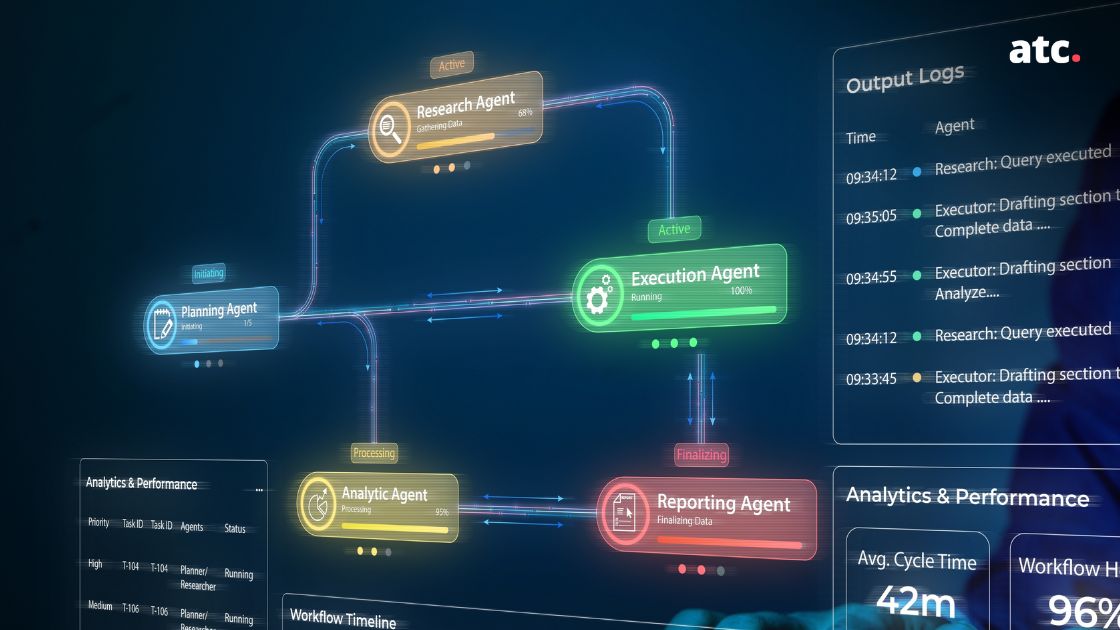
The technical architecture is built from the ground up for serious enterprise deployment. ATC incorporates sophisticated multi-agent orchestration to handle incredibly complex corporate workflows. Think about the daily reality of standard contract approvals. A routine vendor agreement requires input from legal, finance, and operations. The multi-agent orchestration within the ATC Forge Platform perfectly replicates this dynamic digitally. You can deploy specialized artificial intelligence agents that securely interact with each other to analyze a document from multiple distinct perspectives simultaneously. The legal agent checks for liability clauses while the finance agent verifies payment terms against internal budgets. This happens seamlessly within your protected environment. It massively accelerates decision-making without ever exposing the underlying data to the outside world.
Consider the sheer operational efficiency of deploying dedicated artificial intelligence agents for routine customer service triage as well. Instead of a human agent manually routing complex support tickets, multiple specialized models can analyze the sentiment, translate the language, and query the internal knowledge base simultaneously. This orchestration happens entirely behind your corporate firewall. The result is a massive reduction in average handling time without ever exposing your customer interaction history to a third-party public model.
The platform also includes over one hundred pre-built industry accelerators. These customized accelerators allow your engineering and operations teams to completely bypass months of tedious foundational development work. They can focus immediately on high-value customization that drives revenue and actual business results.
Security leaders will deeply appreciate the production-grade MLOps and LLMOps capabilities embedded directly into the system. Every single user interaction operates under military-grade encryption and strict role-based access controls. Full, immutable audit logs give your compliance team absolute visibility into exactly who is using which model. They can see what prompts are executing and what sensitive data is being processed at any given moment.
Crucially, the ATC platform utilizes a highly resilient multi-cloud, multi-LLM architecture. You are never artificially restricted to a single monolithic provider. This flexibility protects your organization from dangerous vendor lock-in. It gives you total control over your own technology future as new, significantly more powerful models inevitably hit the market. Utilizing secure enterprise AI deployment solutions through ATC allows your company to get its strategic initiatives to production two to three times faster than traditional methods. You avoid the heavy over-engineering and unnecessary technical complexity that typically derail internal projects. This approach ensures your teams have the powerful tools they need within a perfectly secure framework.
Conclusion and Actionable Next Steps
Shadow AI is fundamentally an architecture and governance problem. It is not an employee compliance problem. You simply cannot fix a profound technology deficit with an updated employee handbook or a stern corporate memo from human resources. Your people are demonstrating a very clear, persistent demand for advanced tooling to handle the modern workload. The ultimate responsibility falls heavily on IT and operations leaders to provide those tools in a manner that firmly protects the business.
The time to actively build a secure, ROI-driven artificial intelligence roadmap is right now. Ignoring the problem only guarantees that your highly proprietary corporate data will continue flowing out into unauthorized public servers. You need a structured, highly visible environment where rapid innovation and stringent security protocols coexist perfectly.We highly encourage you to explore ATC AI Services to establish a comprehensive, end-to-end strategic partnership. The experienced ATC team handles absolutely everything from rapid proof-of-concept development to highly resilient managed operations running twenty-four hours a day. You can finally give your demanding workforce the powerful capabilities they actually crave while maintaining the absolute control, security, and visibility your corporate posture demands. Take the necessary steps to secure your competitive edge today. Turn the looming Shadow AI crisis into your absolute greatest operational advantage.

Subscribe to the blog