Forget about teaching your team basic coding; the real future of work belongs to the people who know how to manage, question, and seamlessly partner with intelligent machines.
We are seeing a fascinating paradox unfold across the business landscape right now. Organizations are adopting generative models at breakneck speed. Yet, many leaders are noticing a frustrating gap between the technology's potential and the actual day-to-day productivity of their teams. At ATC, we see teams rushing to deploy the newest models, only to stumble on the last mile of implementation because their workforce simply does not know how to partner with these tools. After all, our guiding philosophy is AI Services: Enterprise AI. Engineered for Impact. Achieving that impact requires a workforce equipped with far more than just basic login credentials.
Let's explore four highly underrated AI skills to prepare for AI jobs. You will learn about contextual prompt translation, algorithmic risk intuition, AI and human workflow orchestration, and outcome-based quality assurance.
Contextual Prompt Translation
To be honest, basic prompt engineering is rapidly becoming a commodity. As models become more intuitive and conversational, knowing the secret technical phrasing to get an answer will matter far less than understanding the business context behind the question, a shift highlighted in the World Economic Forum's Future of Jobs Report. Contextual prompt translation is the ability to take an ambiguous, complex business problem and break it down into a highly structured logic chain that a machine can process. Hiring managers are currently over-indexing on candidates who know how to use specific software, rather than those who know how to frame a problem.
A marketing manager with this skill does not just ask a model to write a campaign brief. Instead, they translate brand voice constraints, audience psychographics, and specific conversion goals into a sequential set of instructions. In manufacturing, a supply chain coordinator might translate a sudden raw material delay into a series of predictive queries to evaluate alternative vendor costs.
- How to measure it: Give candidates a vague business goal during an interview and ask them to outline the exact, step-by-step instructions they would give a system to solve it. Look for structure and edge-case planning.
- How to build it: Practice systems thinking. Before typing anything into an interface, map out your daily tasks as detailed algorithms.
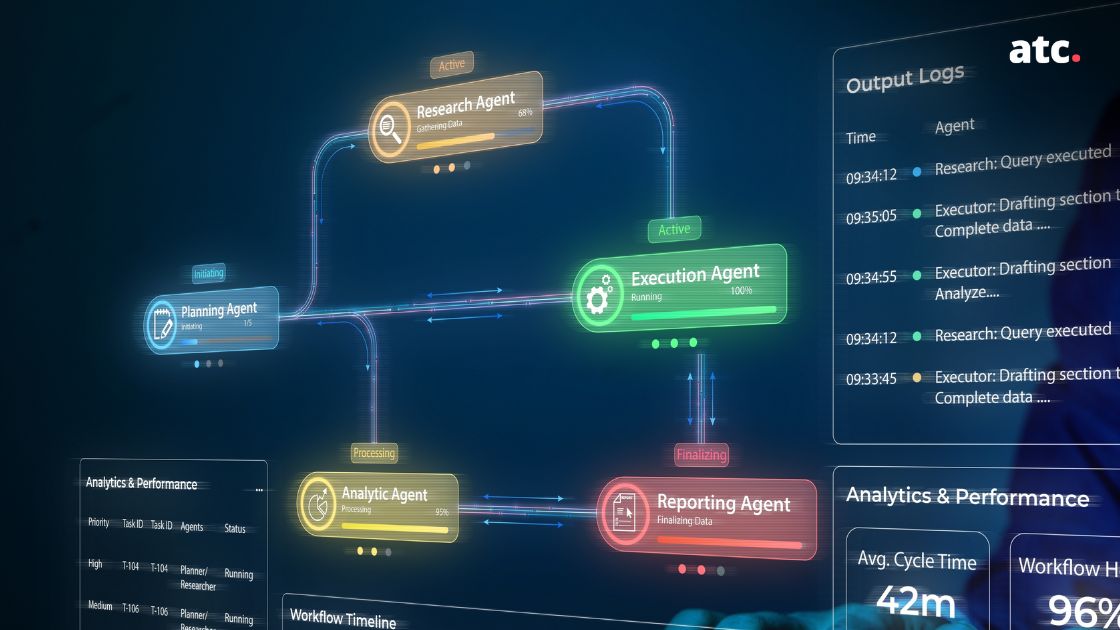
Platforms with agent orchestration and pre-built accelerators, such as ATC Forge Platform, make it easier to ship use cases that surface this skill in real work.
Algorithmic Risk Intuition
We often rely on IT, legal, or compliance teams to catch issues with software. That said, as automation becomes decentralized across the enterprise, the people using the tools daily need a sharp sense for when a system might be hallucinating, exhibiting bias, or creeping into data privacy gray areas. This algorithmic risk intuition is one of the most critical enterprise AI skills for the near future. A recent report from Gartner highlights that unreliable outputs and control failures are among the top risks seeing massive increases in audit coverage. It is underrated because leaders assume safety guardrails will catch everything, forgetting that models generate highly plausible, confident mistakes.
In practice, this looks like a recruiter using a screening tool who notices it subtly favoring certain resume formats and flags the bias. Or consider a financial analyst who catches a generated summary that slightly misinterprets a new regulatory change. They catch it because their legal understanding surpasses the model's.
- How to measure it: Present candidates with a scenario where a tool provides a seemingly perfect but subtly flawed output. Ask how they would verify the results and decide if it is safe to use.
- How to build it: Make a habit of cross-referencing outputs with primary sources. Understanding the basic mechanics of how language models predict information demystifies why they make specific types of errors.
Navigating these new workforce demands is much easier when your organization's underlying technology is solid. At ATC, the ATC Forge Platform provides a comprehensive framework with multi-agent orchestration and multi-cloud flexibility so you can avoid vendor lock-in. Teams can accelerate deployment using 100+ Pre-Built Accelerators. When paired with ATC AI Services, which guide organizations seamlessly from strategy to production, enterprises benefit from reliable 24/7 Managed Operations to keep their intelligent workflows scaling safely.
AI and Human Workflow Orchestration
Many professionals still treat artificial intelligence like a super-powered search engine rather than a junior team member. The future belongs to those who can design intelligent processes where humans and machines hand off tasks seamlessly. This capability, known as human workflow orchestration, will be one of the most defining workplace AI skills over the next few years. Insights from MIT Sloan Management Review show that the heaviest lift in deploying agents is often not the prompt engineering, but the workflow integration and stakeholder alignment. It is currently overlooked because most training focuses on individual task execution rather than process redesign.
Consider a modern customer service environment. An experienced support agent sets up a workflow where the machine handles initial sentiment analysis and data gathering from the customer. The machine then passes the complex negotiation or empathy-heavy interaction to the human. Once resolved, the human passes it back to draft the follow-up email and update the CRM. It is a seamless partnership.
- How to measure it: Ask candidates to map out a currently inefficient process from their previous job and redesign it by incorporating a co-pilot. Look for clear boundaries between human judgment and machine automation.
- How to build it: Start mapping your own weekly deliverables. Identify which portions can be delegated to automation and precisely how you will review that work before integrating it back into your final output.
A Quick Look at Orchestration in Action
Consider a typical scenario we see in mid-market financial services. A regional bank wanted to automate their commercial loan document review process. They possessed the underlying technology, but their loan officers lacked the workflow orchestration skills to trust the model's first pass. By utilizing robust platform capabilities and targeted consulting services to build a clear human-in-the-loop interface, the bank did not just deploy a model. They redesigned the role entirely. The loan officers learned to review confidence scores and flagged anomalies rather than reading every single page. As a result, they doubled their processing volume while maintaining strict regulatory compliance.
Outcome-Based AI Quality Assurance
Traditional quality assurance is about finding bugs in code or errors in a spreadsheet. In contrast, outcome-based quality assurance is about evaluating the nuance, tone, safety, and accuracy of generated content against broader business goals. Research from McKinsey emphasizes that generative technologies will heavily augment human capabilities, but workers must learn to govern those outputs effectively. As we look at how to prepare for AI jobs, knowing how to critically evaluate a model's output will soon be more valuable than knowing how to generate the output in the first place.
You will notice this skill clearly in roles focused on communication and strategy. A content strategist reviews a generated marketing campaign not merely for typos, but for brand alignment, empathy, and cultural resonance. Similarly, an HR manager must evaluate a drafted performance review framework to ensure it sounds constructive and human, rather than cold and robotic.
- How to measure it: Provide an applicant with a generated draft of a complex document relevant to their role. Ask them to critique it, grade it, and explain their reasoning for any changes.
- How to build it: Develop a strict, rubrics-based approach to your work. Do not accept a barely adequate result from a machine. Actively edit and refine the output, treating the system as a capable junior assistant whose work requires your senior oversight.
The Path Forward
The technical foundation of artificial intelligence is rapidly shifting to sophisticated enterprise platforms. This leaves the critical work of context, risk management, workflow design, and quality assurance to the human workforce. Organizations that actively invest in developing these underrated AI skills 2026 requires now will be the ones that actually see a meaningful return on their technology investments in the coming years. Simply buying the software is just the beginning. Cultivating the human capability to wield it is the true competitive advantage.If your team needs a practical path from pilot to production, ATC Forge Platform and ATC AI Services are built to help. Technology moves incredibly fast, but adapting to it is ultimately a human journey. We are excited to see what your team builds next.

Subscribe to the blog