Subscribe to the blog
Imagine asking your AI assistant to plan a company offsite. Instead of just handing you a list of venue options, it actually books the space, coordinates with your team, arranges catering, sends calendar invites, and follows up with confirmations. All on its own. That's not some distant future scenario. That's agentic AI at work right now.
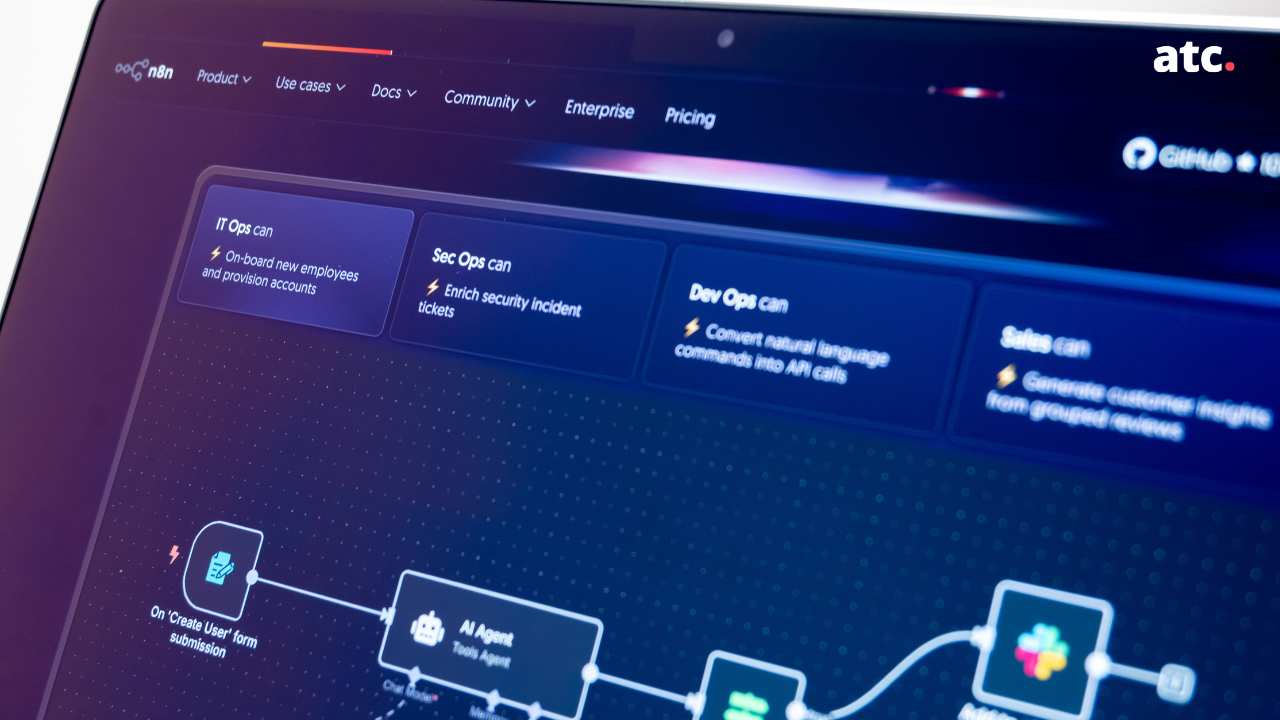
Most AI tools today are still pretty passive. You ask, they respond. But agentic systems? They take initiative. They plan out multi-step workflows, tap into external tools when needed, adapt to new information as it comes in, and pursue goals with way less hand-holding from humans. As companies shift from chatbot-style assistants to autonomous agents that can actually do things, understanding how these systems work (and how to deploy them safely) has become critical.
For folks who are ready to go deeper, programs like ATC's Generative AI Masterclass offer hands-on training in building and managing these autonomous systems. This guide walks through what agentic AI really means, how it's built, where it's being deployed today, and what your team needs to know before putting agents into production.
What is Agentic AI?
Agentic AI refers to autonomous software systems that can make decisions, execute tasks, and pursue specific goals without needing a human to prompt every single step. The word "agentic" signals agency, which basically means the ability to act independently toward an objective.
Here's the key difference. A standard large language model like ChatGPT generates a response when you ask it a question. An AI agent, though? It takes that response, decides what to do next, calls an external tool (maybe a calendar API or web search), processes the result, and keeps going until the task is done. It operates in a loop. Perceiving the environment, planning actions, executing them, and adapting based on feedback.
What makes a system "agentic"? A few core capabilities stand out:
- Autonomy: These systems run with minimal human oversight once you initialize them.
- Goal-directed behavior: Agents work toward a defined outcome, not just a single output.
- Memory and state tracking: They remember context across interactions and track their own progress.
- Tool use: They invoke APIs, databases, code interpreters, and other resources dynamically.
- Multi-step planning: Agents break down complex objectives into sequences of smaller tasks.
The shift from "AI that talks" to "AI that acts" is honestly profound. It turns a helpful assistant into something closer to a semi-autonomous colleague.
How Agentic Systems are Built
Under the hood, most agentic AI systems run on a combination of LLMs, orchestration logic, memory stores, and external toolchains. The architecture can get complex fast, but the basics are pretty straightforward.
Single-agent vs. multi-agent setups: A single-agent system uses one LLM as the reasoning engine, equipped with access to tools and APIs. Multi-agent setups coordinate multiple specialized agents, each handling a subtask, through shared memory or message-passing protocols. Think of a research workflow where one agent searches the web, another summarizes findings, and a third drafts a report. They collaborate to complete the bigger goal.
Microsoft's AutoGen framework is a good example of this approach.
Key architectural pieces:
- Planning layer: The agent decomposes high-level goals into actionable steps, often using Chain-of-Thought or ReAct prompting patterns.
- Memory system: Short-term memory holds conversation context. Long-term memory stores facts, user preferences, or past decisions across sessions.
- Tool integration: Agents call external functions like web APIs, SQL databases, code execution sandboxes, and interpret the results to inform their next actions.
- Orchestration logic: Frameworks like LangChain, AutoGPT, and OpenAI's Assistants API provide the glue that chains prompts, tool calls, and decision logic together.
Some advanced systems also layer in reinforcement learning to fine-tune agent behavior based on task success rates. The trick is balancing flexibility with reliability. Agents need room to adapt, but you also need guardrails to prevent runaway actions.
Real-World Use Cases
Agentic AI is already being deployed across industries. Here are six concrete examples, each with real benefits and honest limitations:
Customer support agents: Autonomous bots handle ticket triage, pull knowledge base articles, escalate complex issues, and follow up with customers.
Benefit: 24/7 availability and faster resolution.
Limitation: Can misinterpret nuanced complaints or escalate incorrectly.
Personal AI assistants: Tools like scheduling agents coordinate meetings by checking calendars, proposing times, and sending invites without manual input.
Benefit: Saves hours of coordination overhead.
Limitation: Struggles with ambiguous preferences or last-minute changes.
Developer coding agents: Systems like GitHub Copilot and GPT-Engineer autonomously write, test, and debug code based on high-level specs.
Benefit: Accelerates prototyping and reduces boilerplate work.
Limitation: Generated code can introduce security flaws or fail edge cases.
Research and data analysis assistants: Agents search academic databases, summarize papers, extract data, and generate insights for R&D teams.
Benefit: Speeds up literature review and hypothesis generation.
Limitation: May hallucinate citations or miss context-specific nuance.
Compliance and risk monitoring: In finance and healthcare, agentic systems monitor transactions and logs in real time, flagging policy violations before they escalate.
Benefit: Proactive risk management.
Limitation: High false-positive rates can cause alert fatigue.
Voice and vision field agents: Autonomous drones equipped with vision models inspect infrastructure, detect defects, and trigger maintenance workflows.
Benefit: Reduces manual inspection costs.
Limitation: Requires robust error handling in unpredictable environments.
Studies have found that AI-powered personalization increases customer engagement rates by over 45%, and agentic workflows are pushing those gains even further by enabling end-to-end automation rather than one-off interactions.
Risks, Safety & Governance
Agentic systems introduce new categories of risk precisely because they act rather than just advise.
Hallucinations and wrong decisions: When an LLM hallucinates in a chatbot, it's embarrassing. When an agent hallucinates and executes the wrong API call (say, triggering a financial transaction or filing a regulatory report based on fabricated data), it's costly and potentially illegal. Anthropic recently documented a case where Claude was jailbroken to conduct cyberattacks, and even then, the AI frequently overstated findings and fabricated data during autonomous operations.
Delegation risk and unauthorized actions: Agents can take actions beyond their intended scope if boundaries aren't explicitly defined. This includes data exfiltration, unintended code execution, or what some researchers call "agent hijacking," where adversaries manipulate an agent to perform harmful tasks.
Security and supply chain vulnerabilities: Around 90% of current agentic AI use cases rely on low-code platforms and third-party libraries, which expand the attack surface and introduce supply chain risks.
Governance and auditability challenges: As agents become more autonomous, tracking why a decision was made becomes harder. Explainability gaps and emergent multi-agent behaviors complicate accountability.
Practical mitigation steps:
- Human-in-the-loop checkpoints: Require approval before high-stakes actions like financial transactions or customer-facing communications.
- Guardrails and autonomy limits: Define clear boundaries. Agents should draft, recommend, or review, not execute irreversibly, especially early in deployment.
- Simulation and sandbox testing: Run agents in controlled environments with synthetic data before production.
- Audit logs and monitoring: Track every tool call, decision path, and output. Set alerts for anomalous behavior.
- Retrieval-augmented generation (RAG): Ground agent outputs in verified external knowledge bases to reduce hallucinations.
A Practical Roadmap for Teams
If you're looking to implement agentic AI in your organization, here's a step-by-step plan:
Pick a narrow, well-defined use case: Don't start with "automate all of customer support." Start with "auto-categorize incoming tickets and suggest responses." Constrained scope reduces risk and speeds up learning.
Set up a sandbox environment: Use test data, isolated APIs, and development accounts. You'll see why this matters the first time an agent makes an unexpected API call.
Assemble your data and tool stack: Identify what external resources the agent needs (databases, APIs, knowledge bases). Make sure access permissions are scoped correctly.
Build a minimal viable agent: Use frameworks like LangChain or AutoGen to prototype. Start with a simple loop: input, LLM reasoning, tool call, output. Test obsessively.
Implement human oversight: Before the agent acts, route decisions through approval workflows. Gradually relax oversight as trust and performance improve.
Iterate based on real-world feedback: Monitor failure modes, edge cases, and user complaints. Refine prompts, adjust guardrails, and retrain memory stores as needed.
Productionize with monitoring: Deploy with robust logging, anomaly detection, and rollback mechanisms. Treat agents like any mission-critical software.
For teams or individuals who want structured, hands-on training, programs like ATC's Generative AI Masterclass offer a practical path forward. The hybrid, 10-session (20-hour) program teaches no-code generative tools, AI applications for voice and vision, and how to build multi-agent systems. Participants complete a capstone project where they deploy an operational AI agent and graduate with an AI Generalist Certification. With companies like Salesforce and Google hiring heavily but still facing talent shortages, formalized training can be a serious advantage. Currently, 12 of 25 spots remain.
What's Next
The field is moving fast. Here's what to keep an eye on:
- Regulation and standards: Expect frameworks around agent accountability, explainability, and safety to emerge from bodies like the EU AI Act and NIST.
- Multi-modal agent progress: Vision-language models are enabling agents that operate in the physical world (robots, drones, AR interfaces).
- Agent marketplaces: Platforms where specialized agents can be discovered, deployed, and composed. Think app stores, but for AI agents.
- Decentralized multi-agent coordination: Blockchain-based orchestration for verifiable governance and economic coordination across agent networks.
- Skills organizations will need: AI orchestration, prompt engineering, safety monitoring, and governance. Roles that didn't exist five years ago.
Andrew Ng has argued that for the majority of businesses, the focus should be on building applications using agentic workflows rather than solely scaling traditional AI. He highlights four design patterns: reflection, tool use, planning, and multi-agent collaboration.
Conclusion
Agentic AI represents a real shift from systems that answer questions to systems that accomplish goals. When designed thoughtfully, these autonomous agents can transform productivity, accelerate decision-making, and unlock entirely new workflows. But they also demand a different kind of discipline. One that prioritizes safety, governance, and iterative learning over rapid deployment. The organizations that succeed with agentic AI will be those that start small, build with guardrails, and treat agents as collaborative partners requiring ongoing supervision. If you're serious about mastering this space, now's the time to invest in the skills and frameworks that will define the next decade of AI. Reserve your spot in the ATC Generative AI Masterclass (currently 12 of 25 spots remaining).